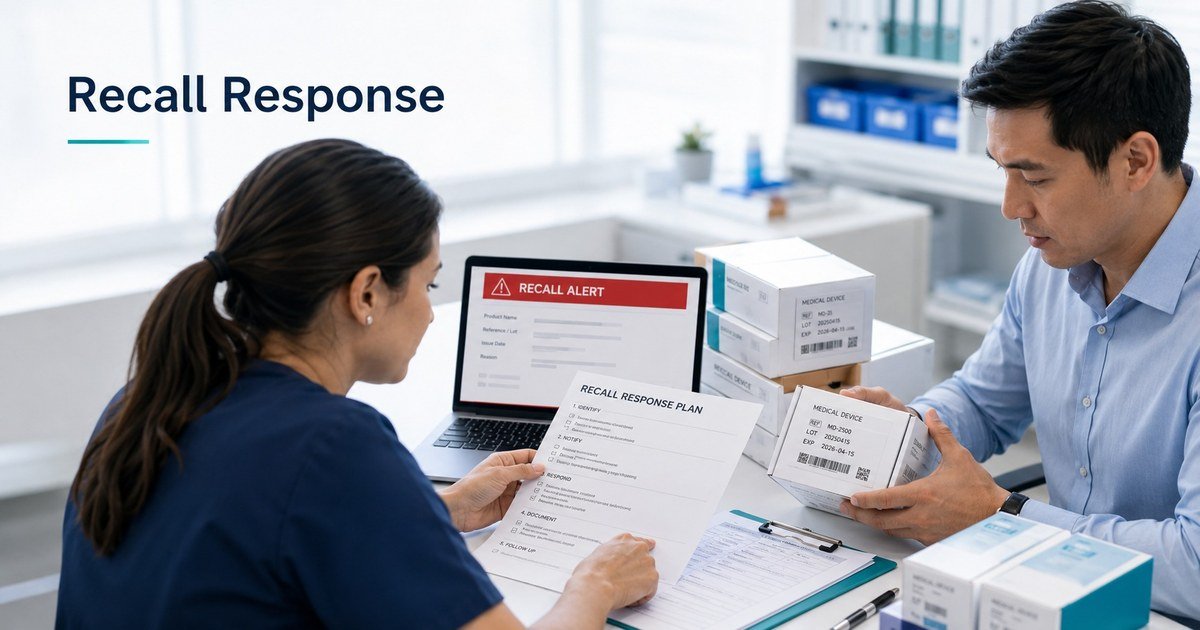
A practical response structure for identifying affected stock, quarantining devices, communicating actions and documenting closure. The purpose is to help teams make a clearer, better documented decision without turning a commercial checklist into a clinical recommendation.
Quick answer
Recall response slows down when supplier contacts, lot records, stock locations and issue history are fragmented. A stronger approach produces a tested process that can identify affected devices quickly and preserve an auditable action trail.
This cluster article supports the broader guide on Medical Device Quality and Compliance: A Buyer Guide. The main search topic for this guide is medical device recall procedure. Related language includes field safety notice medical devices, medical device recall traceability, hospital recall response, but the article uses those terms only where they help the reader rather than repeating them mechanically.
Why this matters
Quality review is not a document collection contest. The strongest file is the one in which every important claim is current, relevant to the exact product and consistent with the label, legal manufacturer, supplier and destination.
For hospital quality teams, procurement, stores and clinical governance, the practical risk is not limited to price. A wrong reference, incomplete pack, uncertain shelf life, late shipment or unsupported alternative can create rework, unused inventory and avoidable delays. A useful buying process therefore connects the technical request, commercial offer and receiving standard.
The best time to resolve ambiguity is before the purchase order. Once goods are dispatched, every unclear field becomes harder and more expensive to correct. The controls below are designed to move important questions to the beginning of the process.
Key checks
| Check | What to do | Why it matters |
|---|---|---|
| Notice authenticity | Confirm the notice through a reliable manufacturer, supplier or authority channel. | False or incomplete messages can create unnecessary disruption. |
| Affected identity | Match product, model, reference, lot, serial and date ranges precisely. | A family name alone may be too broad. |
| Stock location | Identify usable, quarantined, issued, reserved and returned units. | Affected products may be outside the main store. |
| Clinical communication | Route instructions through the appropriate governance channels. | Recall decisions can affect scheduled and completed procedures. |
| Closure evidence | Record quantities reconciled, returned, corrected or otherwise dispositioned. | A recall is not closed when the email is forwarded. |
These checks should be adapted to product risk and organisational policy. A routine low risk item and a sterile implantable or procedure critical device should not automatically receive the same depth of review.
A practical workflow
- Step 1: Validate the notice and appoint an incident owner. Record the owner, evidence and completion date so the action can be checked later.
- Step 2: Translate the affected criteria into searchable identifiers. Record the owner, evidence and completion date so the action can be checked later.
- Step 3: Stop issue and quarantine matching stock. Record the owner, evidence and completion date so the action can be checked later.
- Step 4: Trace distributed or used devices according to policy. Record the owner, evidence and completion date so the action can be checked later.
- Step 5: Complete the required correction, return or other action. Record the owner, evidence and completion date so the action can be checked later.
- Step 6: Reconcile quantities and document formal closure. Record the owner, evidence and completion date so the action can be checked later.
A workflow is only useful when exceptions are visible. If a field is unknown, mark it as unknown and assign an owner. Do not fill the gap with an assumption merely to complete the form. The decision record should show what was confirmed, what remained conditional and which stakeholder accepted the residual risk.
Documentation and verification
Official databases, manufacturer channels and verifiable certification information should be used according to risk. A buyer should record the source and date of an important check because statuses, certificates and commercial arrangements can change.
Receiving, quarantine, complaints and recalls form part of procurement quality. Evidence should remain connected from the approved quotation through delivery, storage and final disposition so that an investigation can be completed without rebuilding the history.
For every important document, record the document title, issuing organisation, product or company scope, version or validity date, source and date reviewed. This simple index helps prevent a valid document from being attached to the wrong product or reused after it becomes outdated.
Minimum decision record
- The original request and clinician or technical approval where required
- The exact quoted product identity, pack and quantity
- Supplier assumptions, deviations and proposed alternatives
- Quality, regulatory and traceability evidence proportionate to risk
- Price basis, landed cost assumptions, lead time and shelf life
- Approval names, dates and any conditions
- Receiving checks and final disposition of discrepancies
Questions to ask before approval
- Can the supplier demonstrate the notice authenticity described in the RFQ, and can the answer be connected to the exact quoted product?
- Can the supplier demonstrate the affected identity described in the RFQ, and can the answer be connected to the exact quoted product?
- Can the supplier demonstrate the stock location described in the RFQ, and can the answer be connected to the exact quoted product?
- Can the supplier demonstrate the clinical communication described in the RFQ, and can the answer be connected to the exact quoted product?
- Can the supplier demonstrate the closure evidence described in the RFQ, and can the answer be connected to the exact quoted product?
Ask suppliers to answer against each RFQ line rather than in a general email. A line level response makes it easier to compare offers, detect partial matches and transfer the approved information into the purchase order.
Common mistakes
- Searching by brand name only. Correct it by returning to the approved requirement, recording the missing evidence and resolving the gap before the order or release decision.
- Failing to include consignment or department stock. Correct it by returning to the approved requirement, recording the missing evidence and resolving the gap before the order or release decision.
- Deleting the original notice after taking action. Correct it by returning to the approved requirement, recording the missing evidence and resolving the gap before the order or release decision.
- Closing the event without quantity reconciliation. Correct it by returning to the approved requirement, recording the missing evidence and resolving the gap before the order or release decision.
Most procurement errors are not caused by one dramatic failure. They develop through several small gaps, such as an abbreviated name, an unrecorded assumption and a receiving check that compares quantity but not reference. Closing those gaps consistently is more effective than adding a large document request after a problem occurs.
Practical example
A field safety notice applies to two lots within a broad product family. Because receiving records include lot numbers, the hospital identifies the affected units in minutes and avoids quarantining unrelated stock.
The lesson is not that every enquiry must become slow. A structured template is usually faster because it reduces repeated emails and makes approval requirements visible from the start.
Final checklist
- Notice authenticity has been reviewed: Confirm the notice through a reliable manufacturer, supplier or authority channel.
- Affected identity has been reviewed: Match product, model, reference, lot, serial and date ranges precisely.
- Stock location has been reviewed: Identify usable, quarantined, issued, reserved and returned units.
- Clinical communication has been reviewed: Route instructions through the appropriate governance channels.
- Closure evidence has been reviewed: Record quantities reconciled, returned, corrected or otherwise dispositioned.
Before closing the file, confirm that the purchase order reflects the approved quotation rather than an earlier draft. At receiving, compare the physical label and condition with the same approved record. This completes the link between request, order and delivered product.
Frequently asked questions
What is a field safety notice?
It is a communication associated with a field safety corrective action. The exact terminology and obligations depend on the applicable regulatory framework.
Why should recall drills be performed?
A drill tests whether contacts, identifiers and inventory records work before a real event.
Who should contact patients or clinicians?
Follow the organisation’s clinical governance and regulatory procedures. Procurement should not independently determine clinical communication.
Related AJA guides
Browse the medical device product catalogue, review the brand sourcing profiles or read about AJA International’s quality and compliance approach.
Send the manufacturer, catalogue number, configuration, quantity, destination and required delivery date. AJA International can review the enquiry and identify any missing information before quoting.
Official resources and further reading
- FDA Quality Management System Regulation
- FDA Unique Device Identification system
- European Commission medical devices sector
Editorial review: Prepared for publication in 2026. Regulatory, registration and product information can change, so readers should confirm current requirements and manufacturer documentation before acting.